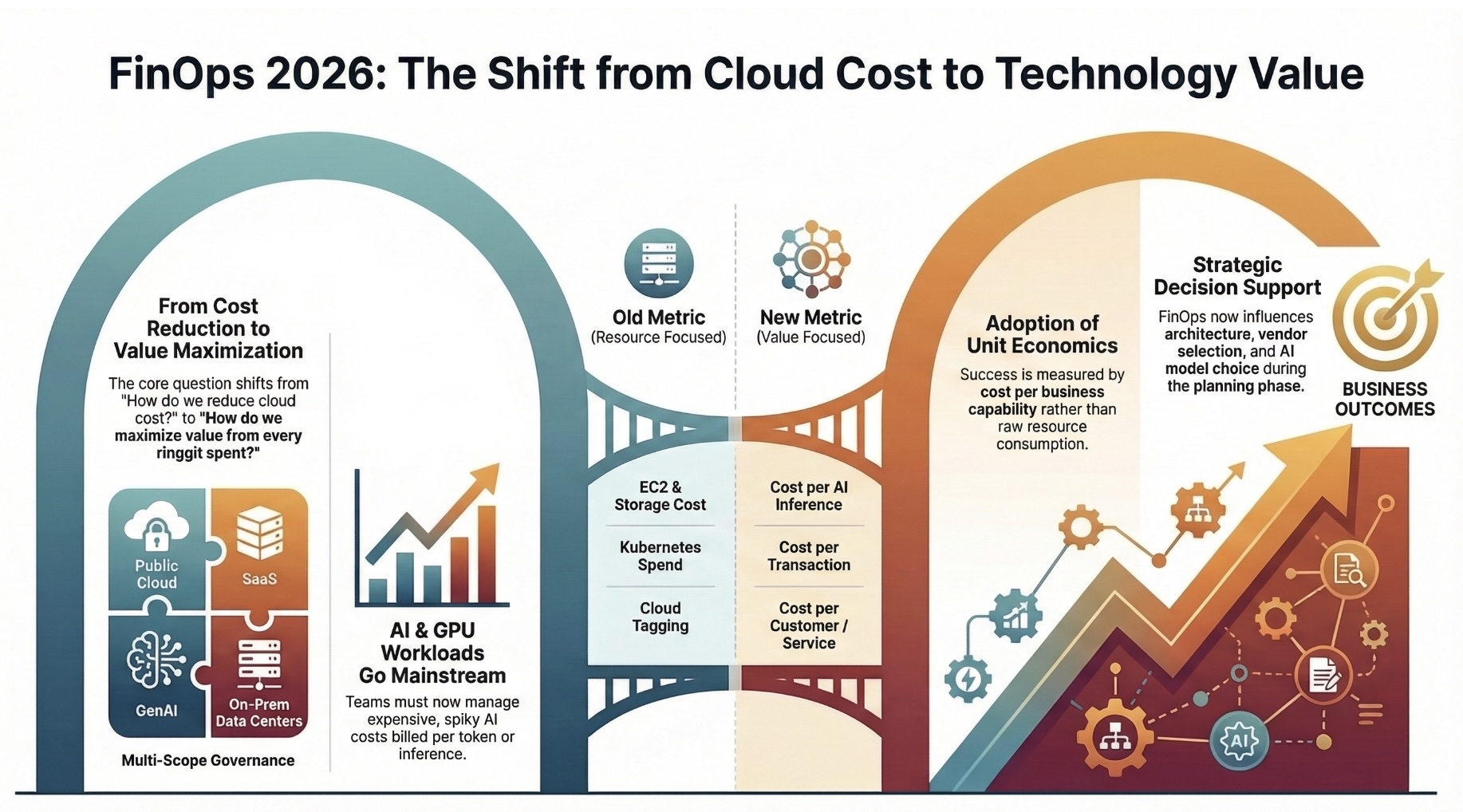

For the past decade, FinOps has been synonymous with cloud cost optimization. Teams focused on rightsizing, reservations, tagging, and cleaning up unused resources. But as we enter 2026, the landscape has changed dramatically. Cloud is no longer the only source of technology spend and optimization alone is no longer enough.
Enter the new era: Technology Value Management.
FinOps is evolving from a cost‑centric discipline into a strategic function that connects technology investment → business value → measurable outcomes. This shift is driven by AI adoption, SaaS explosion, hybrid environments, and increasing pressure on CIOs and CFOs to justify every ringgit spent.
Why 2026 Marks a Turning Point
Three major forces are reshaping FinOps globally and in Malaysia:
1. AI and GPU Workloads Are Now Mainstream
AI is no longer experimental. Enterprises are running:
- LLM inference workloads
- GPU clusters
- Vector databases
- AI-enabled SaaS tools
These workloads behave differently from traditional cloud services. They are:
- Spiky
- Expensive
- Hard to forecast
- Often billed per token, per inference, or per GPU hour
This forces FinOps teams to shift from “reduce cost” to “measure value per AI use case.”
2. SaaS and Licensing Spend Now Exceeds Cloud Spend
Malaysian enterprises are spending heavily on:
- Microsoft 365
- Salesforce
- ServiceNow
- Atlassian
- Security tools
- Industry-specific SaaS
Shadow IT, unused seats, and overlapping tools create silent waste. FinOps must now govern SaaS, licensing, and cloud together.
3. Hybrid & Multi-Technology Environments Are the Norm
Most large organisations in Malaysia operate:
- Public cloud
- Private cloud
- On-prem data centers
- SaaS
- AI platforms
FinOps must evolve from cloud-only to multi-scope technology governance.
From Cost to Value: What This Shift Really Means
The old FinOps question:
“How do we reduce cloud cost?”
The 2026 FinOps question:
“How do we maximise value from every technology ringgit spent?”
This shift introduces new expectations:
1. From Resource Optimisation → Business Unit Value
Instead of reporting:
- EC2 cost
- Storage cost
- Kubernetes cost
FinOps now reports:
- Cost per transaction
- Cost per customer
- Cost per API call
- Cost per AI inference
- Cost per business capability
This is unit economics, and it becomes the core KPI for 2026.
2. From Cloud Tags → Enterprise-Wide Allocation
FinOps teams must allocate spend across:
- Cloud
- SaaS
- Licensing
- AI
- Data center
This requires:
- Unified cost taxonomy
- Standardised tagging/labeling
- FOCUS (FinOps Open Cost & Usage Specification) adoption
- Integration with ITFM and procurement
3. From Optimisation → Strategic Decision Support
FinOps now influences:
- Architecture decisions
- Vendor selection
- AI model choice
- SaaS renewals
- Capacity planning
- Budget cycles
FinOps becomes a strategic advisor, not just a cost controller.
The New FinOps Framework: Scopes and Value Streams
The updated FinOps Framework introduces Scopes:
- Public Cloud
- SaaS
- GenAI
- Data Center
This aligns perfectly with the 2026 shift. Instead of treating cloud as a silo, FinOps teams now manage technology value streams across the entire organisation.
What this enables:
- Unified reporting
- Cross-domain optimisation
- Better forecasting
- More accurate chargeback/showback
- Stronger governance
For Malaysian enterprises with hybrid environments, this is a game changer.
What Malaysian Enterprises Must Do in 2026
1. Build a Multi-Scope FinOps Practice
Move beyond cloud-only. Include:
- SaaS
- Licensing
- AI
- Data center
This requires new skills, new dashboards, and new governance models.
2. Implement Unit Economics
Shift from cost reporting to value reporting:
- Cost per user
- Cost per service
- Cost per transaction
- Cost per AI inference
This is the language CFOs and CEOs understand.
3. Strengthen Governance & Policy
Regulated industries in Malaysia (utilities, telco, BFSI, GLCs) must adopt:
- Policy-as-code
- Budget guardrails
- Automated anomaly detection
- Pre-deployment cost reviews
4. Integrate FinOps with Procurement & Architecture
FinOps must sit at the table during:
- RFP evaluations
- SaaS renewals
- Architecture reviews
- AI model selection
This prevents cost surprises before they happen.
5. Build a Technology Value Dashboard
Executives want:
- Total technology spend
- Spend by scope
- Value metrics
- Forecast accuracy
- AI cost vs value
This becomes the new “CIO dashboard” for 2026.
Closing Thought
FinOps in 2026 is no longer about reducing cloud bills. It is about maximising technology value across cloud, SaaS, AI, and data center environments. Organisations that embrace this shift will gain competitive advantage. Those that don’t will struggle with rising costs, poor visibility, and misaligned investments.
